Combed cotton and ring-spun cotton are not the same thing, and mixing them up costs apparel buyers real money. Here is the short version: combed is a fiber preparation step that removes short, weak fibers before spinning; ring-spun is a spinning method that twists fibers into a tighter, finer yarn. A shirt labeled combed ring-spun has gone through both processes, and that combination is the premium baseline for soft, durable, print-ready T-shirts.
Quick decision guide:
- Budget promos and giveaways: carded open-end cotton is fine. Coarser hand, lower cost, acceptable for one-time use.
- Solid retail basics: ring-spun (carded) delivers noticeably better softness and durability than open-end at a modest price step-up.
- Premium statement tees, DTG, and high-resolution screen prints: combed ring-spun is worth the premium. Smoother surface, better print fidelity, longer wear life.
Table of Contents
- What do ringspun vs combed cotton actually mean?
- How do combed, ring-spun, and combed ring-spun compare?
- Which fabric should you choose for your T-shirt?
- What to expect when you wash combed and ring-spun cotton
- How to read a label and spot vague claims
- Common misconceptions the industry keeps repeating
- Key Takeaways
- Why combed ring-spun is the only choice for statement tees
- Liberallabel statement tees: built on combed ring-spun cotton
- Useful sources
What do ringspun vs combed cotton actually mean?
Every cotton T-shirt starts as raw fiber that travels through a sequence of mechanical steps before it becomes yarn. Understanding where each term fits in that sequence is what makes label claims readable.
The pipeline, step by step:
- Ginning — raw cotton is cleaned and seeds are removed.
- Carding — fibers are opened, cleaned further, and loosely aligned into a rope-like sliver. All cotton goes through carding. The result is carded cotton, which still contains short fibers and some impurities.
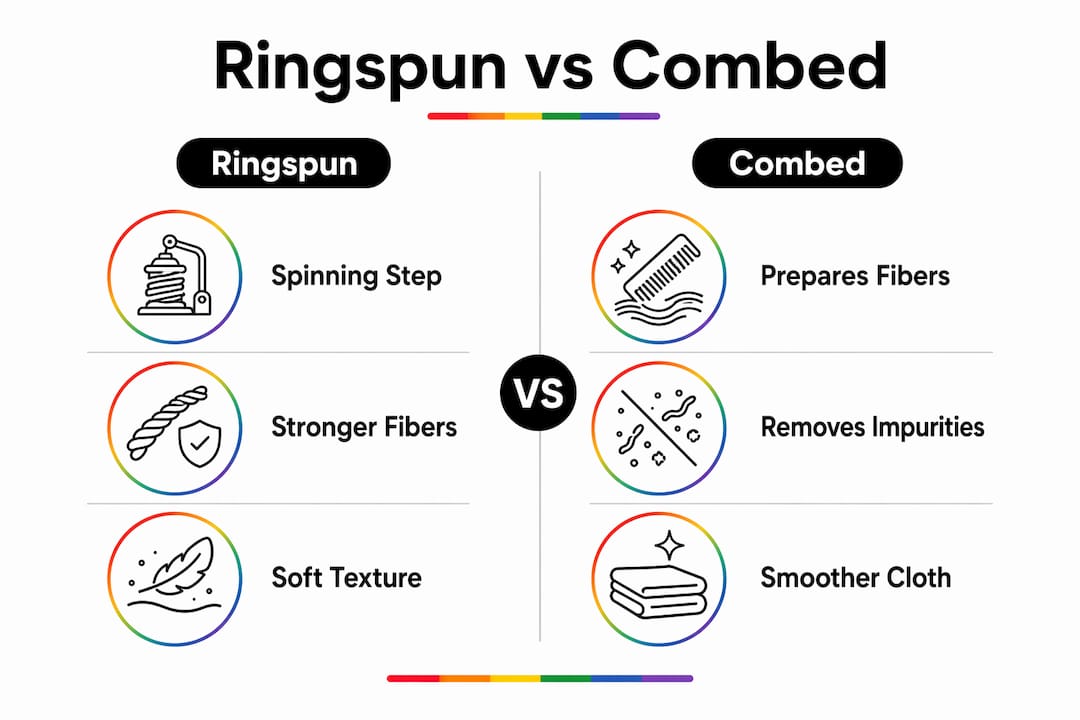
- Combing (optional) — the carded sliver passes through fine metal combs that pull out short fibers (typically under half an inch) and any remaining neps or debris. Only the longest, most uniform fibers survive. This is what combed cotton means: a fiber-prep step, not a spinning method.
- Drawing and roving — fibers are further aligned and drafted into a thinner strand.
- Spinning — the roving is twisted into yarn. Two main methods:
- Ring spinning: fibers feed continuously onto a ring spindle, twisting tightly into a compact, strong yarn. This is what ring-spun means.
- Open-end (rotor) spinning: faster and cheaper, but the yarn is coarser with a messier fiber arrangement and a hairier surface.
The key insight: combing and ring-spinning happen at different stages. A yarn can be ring-spun without being combed (common in mid-tier blanks), and combing always precedes spinning in premium lines. When a label says combed ring-spun, it means the fiber went through both the combing prep step and the ring-spinning method, which is why the two terms are not interchangeable.
How do combed, ring-spun, and combed ring-spun compare?
| Attribute | Carded Open-End | Ring-Spun (Carded) | Combed Ring-Spun |
|---|---|---|---|
| Softness / hand | Rough, scratchy | Noticeably softer | Softest; buttery feel |
| Durability / strength | Lower | Higher tensile strength than open-end | Strongest; long fibers + tight twist |
| Pilling resistance | Pills quickly | Better than open-end | Best; short fibers removed before spinning |
| Yarn structure | Short, loose fibers; irregular twist | Longer fibers; consistent twist | Longest fibers only; tightest, most uniform twist |
| Shrinkage and care | Higher shrinkage risk | Moderate | Slightly lower distortion due to tighter structure |
| Print quality (DTG / screen) | Fuzz interferes with ink | Good surface | Best print substrate; flat, minimal fuzz |
| Weight / perceived heft | Often heavier for same oz | Balanced | Lighter feel at same GSM due to finer yarn |
| Cost premium | Lowest | Moderate | Highest |

Combed ring-spun is the preferred baseline for fashion-forward blanks because it stacks every advantage: the combing step removes the short fibers that cause pilling and surface fuzz, and the ring-spinning method locks the remaining long fibers into a tight, smooth yarn. The result is a shirt that feels premium on day one and holds up after dozens of washes.
Open-end yarn, by contrast, has a messier cross-wrapped fiber arrangement under a microscope. That rougher surface is exactly what makes ink sit unevenly and causes prints to look blurry at fine detail edges.
Pro Tip: When ordering blanks for decoration, always check the singles count alongside the spinning and combing designation. A 4.2 oz 32s combed ring-spun tee will feel and print better than a 6.0 oz 18s open-end tee, even though it weighs less. Specify singles (30s–36s), GSM, and "combed ring-spun" on your tech sheet to prevent procurement mismatches.
Which fabric should you choose for your T-shirt?
The right choice depends on what the shirt needs to do.
- Everyday retail tee: Ring-spun (carded) hits the sweet spot. Soft enough for daily wear, durable, and priced for volume.
- Premium statement tee or brand direct-to-consumer: Combed ring-spun. The smoother hand and better print surface justify the cost when the shirt represents your brand.
- DTG or photo-realistic prints: Combed ring-spun, 30s singles or higher. The flat surface reduces pretreatment variability and keeps photographic detail sharp.
- Multi-color screen printing: Combed ring-spun. Cleaner edges, less ink bleed, better color pop on a smooth substrate.
- Heavyweight streetwear: Ring-spun at higher GSM (180–240 GSM range) is common; combed ring-spun at the same weight adds a premium hand without sacrificing structure.
- Bulk promo runs and giveaways: Carded open-end is acceptable. Nobody expects a trade-show freebie to feel like a boutique tee.
| Priority | Recommended fabric tier |
|---|---|
| Lowest cost | Carded open-end |
| Softness + durability, moderate budget | Ring-spun (carded) |
| Best print quality + premium feel | Combed ring-spun |
| DTG / photo print | Combed ring-spun, 30s+ singles |
When ring-spun alone is enough: if the design is a simple one-color print and the shirt is priced for everyday retail rather than a collector piece, carded ring-spun performs well and saves margin. When combed ring-spun is non-negotiable: any shirt where print longevity, softness after repeated washing, or photorealistic DTG output matters to the buyer.
What to expect when you wash combed and ring-spun cotton
Cotton shrinks. That is not a defect; it is physics. The question is how much and how to minimize it.
Combed ring-spun cotton tends to show slightly less dimensional distortion after washing compared with open-end cotton. The reason is structural: longer staple fibers and a tighter yarn twist leave less room for the fabric to contract unevenly. That said, no untreated cotton is shrink-proof, and the first wash typically causes the most change regardless of yarn type.
Washing and drying guidance:
- Water temperature: cold or warm (up to 86°F / 30°C) preserves fit best. Hot water accelerates fiber relaxation and shrinkage.
- Detergent: a mild, pH-neutral detergent protects both the fabric and any printed graphics. Avoid bleach on colored or printed tees.
- Drying: tumble dry on low heat or air-dry flat. High heat is the single biggest driver of post-wash shrinkage and print cracking.
- First wash: turn the shirt inside out before the first wash to protect the print surface and set the fit.
- Ironing: if needed, iron inside out on a low setting; never iron directly over a screen-printed or DTG graphic.
On the cost of combing: the combing step physically discards roughly 15–20% of the raw cotton sliver as noils (short, weak fibers). That material loss is built into the price of combed cotton. A higher blank cost is not markup padding; it reflects real fiber that was removed to improve the yarn.
How to read a label and spot vague claims
Labels and product pages are not always honest about what is inside the shirt. Here is what to look for and what to question.
Checklist: what a solid spec should include
- The word "combed" stated explicitly, not implied by "premium" or "soft-touch."
- The word "ring-spun" or "ring-spun combed" to confirm the spinning method.
- Singles count (e.g., 30s, 32s, 36s). Higher singles = finer, smoother yarn.
- GSM or oz per square yard (e.g., 150 GSM / 4.4 oz). Weight tells you heft and drape.
- Any finishing treatments (pre-shrunk, enzyme-washed, airlume) that affect hand and dimensional stability.
Red flags to watch for:
- "Premium cotton" or "soft cotton" with no further specification. These phrases mean nothing without a singles count and spinning designation.
- "Ring-spun" listed with no singles count or weight. Ring-spun 18s and ring-spun 36s are very different fabrics.
- No mention of combing on a blank marketed for DTG or high-resolution printing.
- GSM listed but no yarn type. A 180 GSM open-end tee and a 180 GSM combed ring-spun tee are not the same product.
"Experts recommend specifying both combed and ring-spun plus singles and GSM on tech sheets to avoid spec ambiguity." — VersusGuy textile analysis
When in doubt, ask the supplier for a tech sheet or request a sample swatch before committing to a production run. A supplier who cannot produce a tech sheet is a supplier worth reconsidering.
Common misconceptions the industry keeps repeating
The most persistent error in apparel sourcing is treating "ring-spun" and "combed" as synonyms. They are not. Combing is a preparatory removal of short fibers; ring-spinning is a spinning method. A fabric can be ring-spun without being combed, which is exactly why mid-tier blanks labeled only "ring-spun" feel noticeably different from those labeled "combed ring-spun."
The cost difference has a concrete explanation. Combing discards roughly 15–20% of the raw sliver as noils. Those noils are short, weak fibers that would otherwise end up in the yarn, contributing to pilling and surface fuzz. Removing them improves the fabric but reduces yield, and that reduced yield is why combed cotton costs more per yard.
Wholesale and decorator specialists note that combed ring-spun cotton reduces print rejects and customer complaints for retail programs, offsetting the higher blank cost through lower waste and better end-customer satisfaction. — Bulkthreads wholesale guide
For decorated apparel, the surface quality difference is not cosmetic. Combed ring-spun improves screenprint edge definition and DTG photorealism because there is less surface fuzz to interfere with pretreatment and ink bonding. A cheaper blank that requires a reprint run or generates customer returns is not actually cheaper.
Pro Tip: If a supplier's product page says "100% cotton" with no further detail, that is almost always carded open-end. Combed ring-spun is a selling point; suppliers who use it say so.
Key Takeaways
Combed ring-spun cotton is the clear premium choice for soft, durable, print-ready T-shirts because it combines fiber refinement and tight yarn construction into the best available cotton substrate.
| Point | Details |
|---|---|
| Combed vs. ring-spun are different steps | Combing preps fibers; ring-spinning constructs the yarn — they are complementary, not synonyms. |
| Combed ring-spun = best all-around | Softest hand, strongest yarn, best pilling resistance, and flattest print surface of any cotton option. |
| Cost premium is real and justified | Combing removes roughly 15–20% of raw fiber as noils, which directly raises blank cost. |
| Match specs to decoration method | For DTG or high-res screen printing, specify 30s+ combed ring-spun and confirm singles count and GSM. |
| Liberallabel uses combed ring-spun | Liberallabel's statement tees are built on soft, unisex combed ring-spun blanks for comfort, print clarity, and long wear life. |
Why combed ring-spun is the only choice for statement tees
There is a version of this conversation where you weigh the cost difference and decide a cheaper blank is close enough. For a trade-show giveaway, maybe. For a shirt that carries a message you actually believe in, it is a different calculation.
At Liberallabel, the choice to use combed ring-spun cotton is not a marketing decision. It is a practical one. A statement tee gets worn repeatedly, washed repeatedly, and seen by people who form an impression of the message partly based on how the shirt looks and feels. A print that cracks after ten washes or a fabric that pills and loses its shape undermines the message it is carrying. Combed ring-spun holds its hand, holds its print, and holds its shape in a way that cheaper yarns simply do not.
There is also a sourcing dimension worth naming. The combing step removes material that would degrade the final product, which means less fiber wasted on low-quality output. That is not a sustainability certification claim; it is just how the process works. Better fiber selection upstream produces less waste downstream in returns, reprints, and discarded garments.
The conventional wisdom in budget apparel is that fabric quality is invisible to the end customer. Anyone who has worn a genuinely good combed ring-spun tee next to a carded open-end one knows that is wrong. The difference is immediate and tactile.
Liberallabel statement tees: built on combed ring-spun cotton
If you have read this far, you know what separates a shirt worth wearing from one that just fills a drawer. Liberallabel's statement T-shirts are printed on soft, unisex combed ring-spun blanks chosen specifically for their smooth hand and print-ready surface. Every design is meant to start a conversation, and a shirt that looks sharp after fifty washes does that job better than one that fades and pills after five.

Size-inclusive fits, domestic and international shipping, and designs that say something worth saying. Browse the full collection at Liberallabel and find the tee that fits what you believe.
Useful sources
| Source | What it covers |
|---|---|
| LeelinePromotion: What Is Ring Spun Cotton? | Ring-spinning mechanics, tensile strength vs. open-end, microscopic fiber structure |
| Bulkthreads: Ring-Spun vs Open-End vs Combed Cotton | Wholesale buyer comparison; singles/GSM interaction; DTG and screen-print substrate guidance |
| CKP Textile: Cotton Combed | Combing process detail; noils yield loss (15–20%); cost premium explanation |
| MEXESS: Ring Spun vs Combed Cotton | Label confusion clarification; combing vs. ring-spinning as distinct production stages |
| VersusGuy: Ring Spun Cotton vs Combed Cotton | Expert perspective on spec-sheet best practices; pilling resistance from combing |
| Three Layer: Ringspun Cotton vs Regular | Combed ring-spun as premium fashion-blank baseline; pilling and finish comparison |